
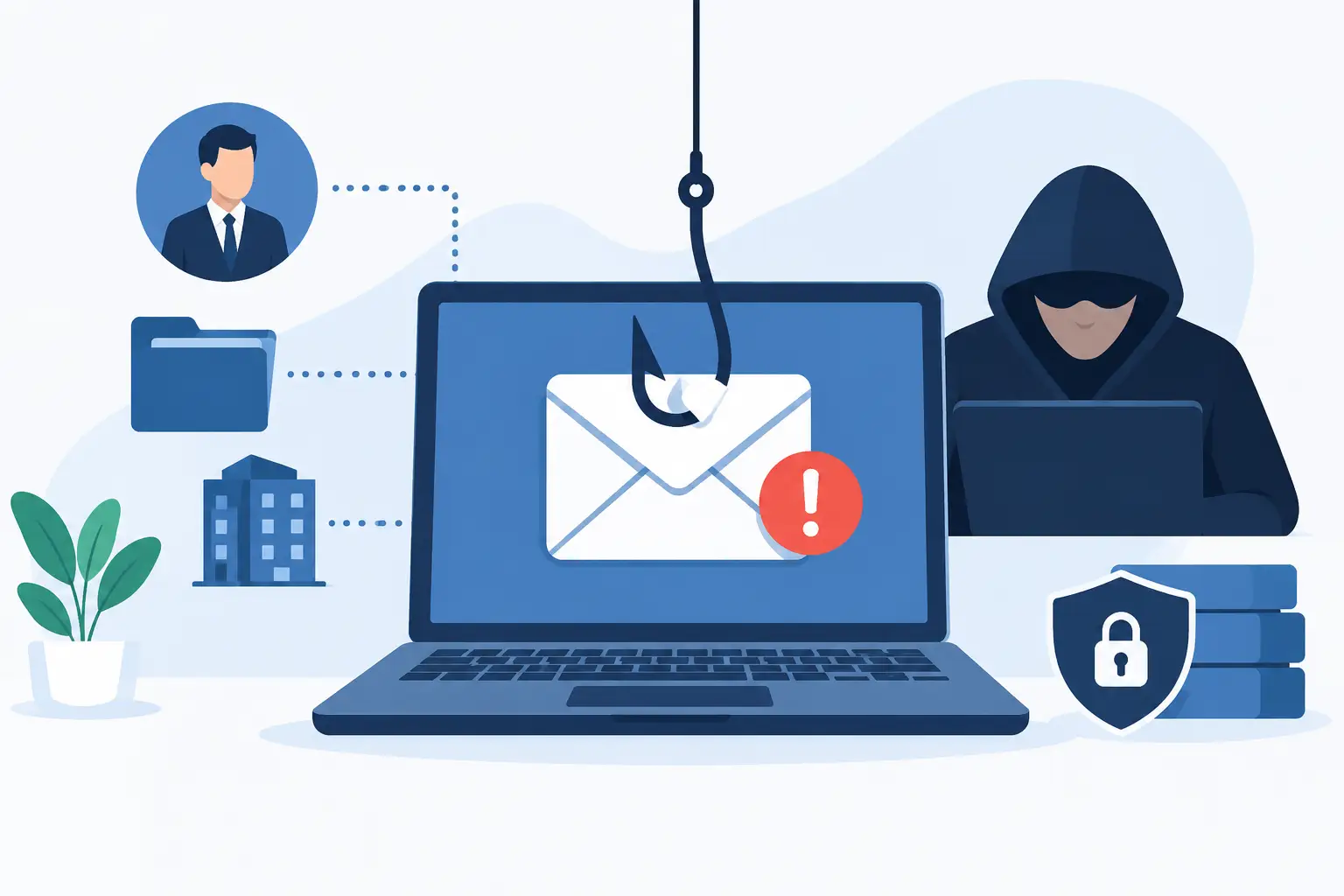
A payment instruction that appears to come from a finance director can cost more than a conventional malware incident - and leave far less forensic evidence behind. Understanding what causes business email compromise is therefore not an academic exercise. It is central to protecting payment processes, supplier relationships, sensitive information and executive trust.
Business email compromise, often shortened to BEC, is an impersonation-led fraud. The attacker persuades a recipient to transfer funds, amend bank details, disclose data or take another high-impact action. They may compromise a genuine mailbox, but they do not always need to. A carefully registered lookalike domain, credible research and a well-timed message can be enough.
For UK organisations, BEC should be treated as a business-risk problem with technical, procedural and human components. Email security is necessary, but it cannot independently validate whether a payment request is legitimate.
What causes business email compromise?
BEC succeeds when an attacker can make an unusual request look routine, urgent or authorised. The immediate cause may be a stolen Microsoft 365 credential, a spoofed supplier address or an executive whose public profile reveals too much. The underlying cause is usually a gap between security controls and the way the organisation actually approves money, data and account changes.
Attackers are selective. They identify people with access to payments, payroll, invoices, client matters or confidential information, then tailor an approach around known processes. A finance team member who receives a convincing instruction at the end of a busy reporting period is facing a different risk from a receptionist receiving generic phishing at scale.
Compromised credentials and weak identity controls
Stolen usernames and passwords remain a common route into business email accounts. Credentials may be obtained through phishing, password reuse following a third-party breach, malware or adversary-in-the-middle attacks that capture session tokens. Once inside a mailbox, an attacker can read prior correspondence, identify suppliers and imitate the sender's writing style.
Multi-factor authentication materially reduces this risk, but the method and configuration matter. Basic MFA may still be vulnerable to repeated push notifications, social engineering or session theft. Conditional access, phishing-resistant authentication, device posture checks and sensible controls over legacy protocols provide stronger protection. Equally, privileged accounts and accounts used by finance, payroll and senior leadership deserve particular attention.
Supplier impersonation and lookalike domains
Not every BEC incident involves a breached internal account. Attackers often register domains that differ by one character, use display-name spoofing, or compromise a genuine supplier mailbox. They may send a revised invoice stating that banking arrangements have changed, then follow up with a phone call or further emails to create legitimacy.
This works because supplier payment changes are often handled under time pressure and because email is wrongly treated as sufficient evidence of identity. Domain-based protections such as SPF, DKIM and DMARC help reduce unauthorised use of an organisation's own domain. They do not, however, prove that an authentic supplier message requesting a new bank account is genuine.
Public information and social engineering
Company websites, tender notices, social media posts and public filings can give attackers a useful map of an organisation. They can identify directors, current projects, office locations, supplier relationships and periods of organisational change. A criminal who knows that a chief executive is travelling, or that a firm has recently acquired another business, can produce a message that sounds plausible rather than generic.
The request itself exploits normal workplace behaviour: respect for seniority, a desire to be helpful and reluctance to delay an urgent matter. BEC emails commonly ask for discretion, speed or an exception to normal process. Those signals are particularly effective where staff believe escalation will be seen as obstructive.
Weak payment and change-control processes
The most damaging gap is frequently procedural. If one person can create or amend supplier details and release a payment, an attacker needs only one successful deception. If a bank-detail amendment can be verified using a telephone number included in the suspicious email, the control is easily redirected by the attacker.
A defensible process separates duties and requires out-of-band verification using trusted contact details already held in the supplier record. The person requesting or entering a change should not be the sole person authorising it. Payment approval thresholds, exception handling and audit trails should reflect the value and risk of the transaction, not merely the convenience of the workflow.
This is not an argument for making every low-value invoice burdensome. The appropriate control depends on transaction value, supplier criticality, geography and fraud history. The key is to design proportionate friction at the points where a fraudulent action would be hard to reverse.
Inadequate email monitoring and response capability
Attackers who gain mailbox access may create hidden forwarding rules, delete replies, mark messages as read or add inbox rules that conceal correspondence from the legitimate user. In some cases, they monitor a conversation for weeks before intervening at the ideal moment.
An email security platform should inspect inbound threats, impersonation indicators and suspicious links or attachments, while identity and SaaS security controls should identify unusual logins, risky OAuth application consent and anomalous mailbox-rule creation. Centralised logging is equally valuable. Security teams need to determine who accessed a mailbox, from where, what rules changed and whether other accounts show related activity.
A managed detection and response arrangement can improve coverage where internal teams do not have the capacity to investigate alerts continuously. However, technology selection should follow a clear understanding of existing Microsoft 365 licensing, security operations maturity, integration requirements and the specific fraud patterns the organisation faces.
Why technical controls alone do not stop BEC
Traditional secure email gateways were designed largely to block malicious attachments, links and bulk phishing. BEC messages are often text-only and may come from a legitimate, compromised account. They can therefore pass many conventional checks.
Modern email security should be evaluated for its ability to detect display-name impersonation, lookalike domains, unusual communication patterns and account takeover signals. Yet the strongest tool cannot decide whether a chief financial officer truly intends a confidential payment. That decision requires a verified business process.
The practical objective is layered control: reduce the chance of deceptive messages arriving, limit the impact of compromised accounts, and ensure that a successful impersonation attempt cannot directly trigger an irreversible financial or data-related action.
Building a proportionate BEC defence
A useful starting point is to map the business processes that attackers would target. This normally includes supplier onboarding, bank-detail changes, payment release, payroll amendments, property transactions, client data requests and executive communications. Identify who can initiate, approve and verify each action, then test whether the process still holds if their mailbox has been compromised.
The following control areas should be assessed together:
- Identity security, including phishing-resistant MFA, conditional access, least privilege and monitoring of risky sign-ins.
- Email protection, including anti-impersonation capability, domain authentication, malicious-content inspection and post-delivery remediation.
- Finance controls, including dual authorisation, independently sourced call-back details and documented escalation for exceptions.
- Security awareness training that uses realistic, role-specific BEC scenarios rather than generic phishing examples.
- Incident response procedures that define who contacts the bank, suppliers, insurers, legal advisers and law enforcement when fraud is suspected.
Training is most effective when it supports a culture in which staff can challenge unusual instructions without fear of criticism. Finance, payroll and executive support teams should be practised in identifying pressure tactics, verifying changes and reporting concerns quickly. Simulated exercises can expose process weaknesses, but they should be used to improve decisions, not simply measure who clicked.
Selecting the right controls for your environment
There is no single best BEC product or architecture. An organisation using Microsoft 365 with a small IT team may need a managed, easily operated email-security layer and straightforward identity hardening. A regulated firm with a security operations centre may prioritise integration with SIEM, XDR and governance, risk and compliance workflows. Larger groups may also need controls that account for subsidiaries, multiple email tenants and complex supplier estates.
Buying decisions should consider detection quality, administrative overhead, licensing overlap, deployment effort and response support. A separate email-security platform may add valuable impersonation detection and specialist workflow controls, but only if it complements rather than duplicates existing tooling. Independent comparison is useful here because the best fit depends on operational requirements, not on a predetermined vendor preference.
ITR Cyber helps organisations assess these trade-offs across email security, identity protection, security awareness and wider detection capabilities, with recommendations based on the risk and operating model rather than a single product catalogue.
When a payment request or bank-detail change feels urgent, the safest response is rarely a faster email reply. Verify it through a trusted channel, pause the transaction where necessary, and treat that pause as a functioning security control rather than an administrative delay.