
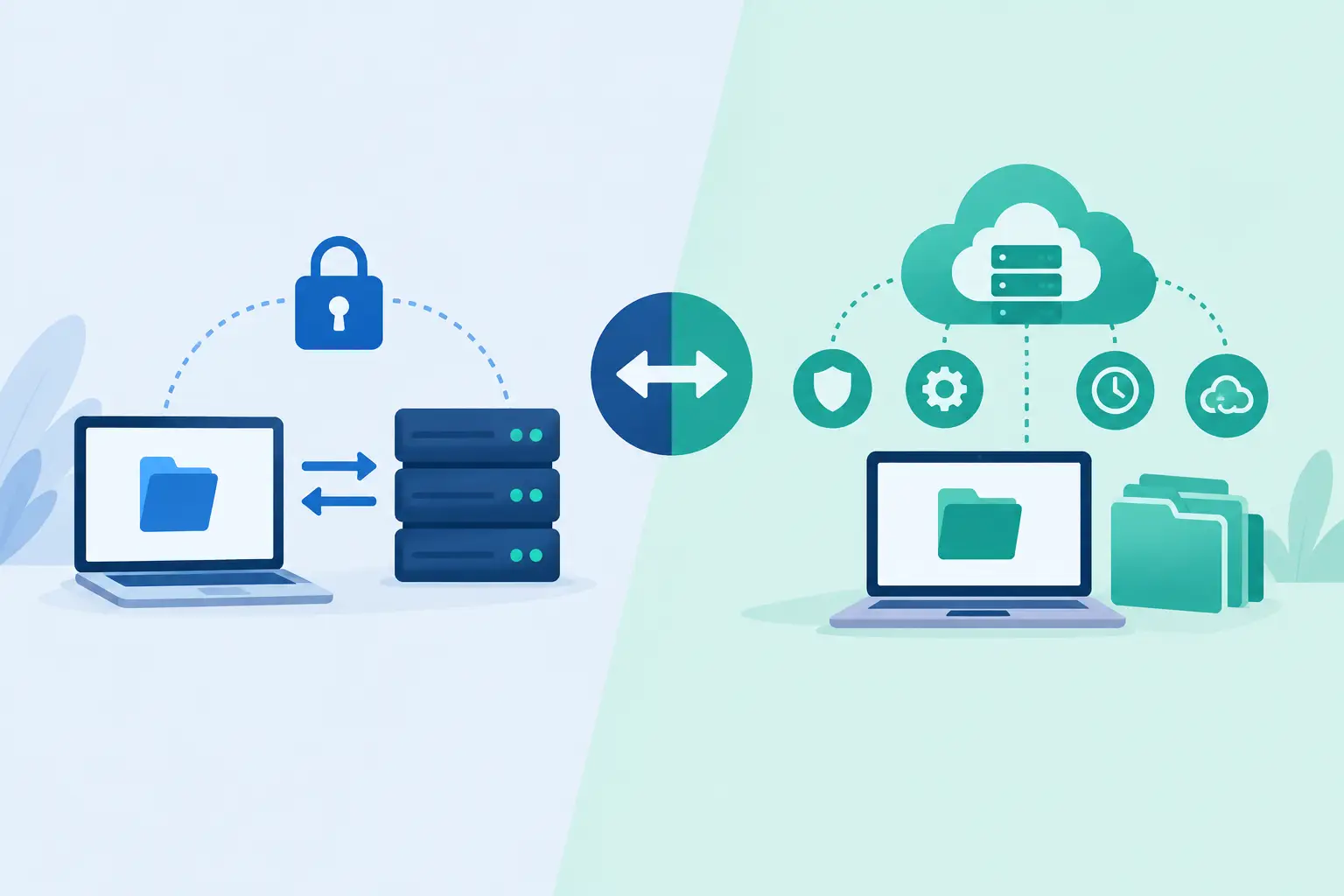
A finance team sends payroll files to an outsourced provider. A hospital exchanges patient-related records with a laboratory. A manufacturer receives production data from dozens of suppliers. In each case, an encrypted connection alone is not the full control requirement. That is the practical distinction behind SFTP vs managed file transfer: one is a secure transfer protocol, while the other is a governed operational capability.
SFTP can be a sensible, cost-effective choice for a defined transfer requirement. Managed file transfer, commonly shortened to MFT, becomes more relevant when file movement carries material operational, regulatory or security risk. The right decision depends less on the size of a file than on what it contains, who handles it, how often it moves and whether the organisation can evidence control.
SFTP vs managed file transfer: the core difference
SFTP, or SSH File Transfer Protocol, encrypts files and commands in transit using Secure Shell. It is widely supported, familiar to technical teams and appropriate for secure point-to-point transfers where users, permissions and processes are tightly controlled. An SFTP server may be hosted internally, in a cloud environment or supplied as a managed service.
MFT is a platform and operating model built around secure file exchange. It may use SFTP as one of several transport methods, alongside HTTPS, APIs, FTPS, AS2 and cloud storage connectors. Its value lies in the controls around the transfer: workflow automation, policy enforcement, audit trails, reporting, alerting, integration and administration at scale.
Put simply, SFTP answers, “Can this file be encrypted while it travels?” MFT addresses the broader questions: “Was it sent to the right recipient? Was it approved? Did it arrive? What happened when it failed? Can we prove compliance six months later?”
What SFTP does well
For a small number of technical integrations, SFTP remains a practical option. It is mature, broadly compatible and straightforward for applications or partners that can authenticate using SSH keys. A well-configured SFTP service can provide strong encryption in transit, individual accounts, restricted directories and controlled network access.
It is often suitable where transfers are infrequent, the data classification is modest, and a capable IT team can manage access, patching, monitoring and incident response. For example, an internal application exporting a nightly report to a known hosted service may not need a full MFT platform if the process is low-risk and adequately monitored.
The limitation is that SFTP is a protocol, not a governance framework. The organisation must build or operate many of the surrounding controls itself. That can include key lifecycle management, account provisioning and deprovisioning, logging, file retention, failure notifications, malware scanning, scheduling, naming rules and reporting. Those controls are achievable, but they can become fragmented as the number of partners and transfers grows.
Where managed file transfer adds value
MFT centralises file exchange across internal teams, suppliers, customers and business systems. Rather than maintaining separate scripts, shared service accounts and manually checked folders, teams can define repeatable workflows with clear ownership.
A mature MFT deployment commonly provides a central administration console, role-based access control, multi-factor authentication, encryption in transit and at rest, detailed audit records, automated notifications and integration with identity platforms. Many platforms can also apply policy-driven controls such as file size limits, expiry dates, content checks, data loss prevention integrations and quarantine workflows.
Automation is often the commercial driver. An MFT platform can collect a file from an ERP system, validate its name and format, encrypt it, deliver it to a third party, confirm receipt and escalate an exception to the correct service team. This reduces manual intervention and lowers the chance that a missed transfer becomes a business disruption.
For regulated environments, the evidential value matters as much as the security capability. Healthcare organisations, financial services firms, legal practices and public-sector bodies may need to demonstrate who accessed a file, what action they took and whether policy was followed. Centralised MFT logging is generally easier to review than records distributed across servers, scripts and partner portals.
A practical comparison for buyers
| Requirement | SFTP | Managed file transfer | | --- | --- | --- | | Encryption in transit | Native SSH encryption | Usually supports SFTP plus other secure protocols | | Point-to-point exchange | Strong fit | Strong fit, particularly at scale | | Workflow automation | Usually custom scripting or external tools | Built-in scheduling, routing, validation and alerts | | Audit and reporting | Server logs, often requiring manual review | Centralised, searchable audit trails and reporting | | Partner onboarding | Manual account and key management | Repeatable onboarding, delegated administration and templates | | Compliance controls | Possible, but depends on configuration and operations | Designed to apply policy and evidence control consistently | | Resilience and exception handling | Depends on the surrounding architecture | Typically includes retries, alerts, dashboards and escalation paths |
Neither option is automatically more secure in every deployment. A poorly configured MFT platform can introduce risk, just as a carefully hardened SFTP service can meet a narrow requirement well. The difference is the breadth of controls available and the effort needed to run them consistently.
Security considerations that should influence the decision
Encryption is necessary but insufficient. File transfers are frequently targeted because they connect organisations to third parties, carry valuable data and may rely on unattended service accounts. Attackers do not need to break the encryption if they can compromise credentials, exploit an unpatched server or manipulate a trusted workflow.
For SFTP, security teams should assess SSH key standards, password controls where passwords are permitted, MFA for administrative access, source IP restrictions, directory isolation, patch management, logging and backup arrangements. Shared accounts deserve particular scrutiny because they weaken accountability. The same applies to keys that are created for a project and then left active indefinitely.
For MFT, evaluate the platform’s identity integration, privileged access model, encryption key handling, API security, vulnerability management process and deployment options. If files contain personal, financial, health or commercially sensitive information, consider whether the platform supports malware inspection, content classification, retention policies and detailed exportable audit data.
Supply-chain exposure also needs attention. A secure internal service does not remove the risk created by a partner’s weak credentials or compromised environment. MFT can make third-party access easier to govern, but procurement and security teams should still define contractual responsibilities, incident notification expectations and onboarding standards.
When SFTP is enough
SFTP is often sufficient when the transfer pattern is simple and stable. Typical examples include a limited number of application-to-application transfers, low-volume operational files and established partners with clear technical ownership. It can also be appropriate where a managed service provider operates the server under an agreed security and support model.
The decision should be supported by evidence, not an assumption that SFTP is inherently basic. If the service has named owners, documented access reviews, monitored logs, tested recovery procedures and defined incident handling, it may be proportionate to the risk.
However, the total cost of ownership needs honest assessment. A low licence cost can be offset by engineering time spent maintaining scripts, resolving failed transfers, responding to user requests and producing audit evidence. That calculation changes quickly when business units begin adding new external recipients or demanding self-service access.
When MFT is the better investment
MFT is usually justified where transfers are business-critical, numerous or subject to compliance oversight. It is particularly relevant when several departments exchange files externally, when integrations are growing, or when operational teams require visibility without direct server administration.
Consider MFT where there is a need to standardise external file exchange after mergers, reduce reliance on email attachments and consumer file-sharing tools, or replace fragile scripts that have become difficult to support. It also suits organisations that need formal separation of duties between administrators, workflow owners and auditors.
A platform should not be selected purely on a long feature list. Some organisations need high-volume B2B integration and AS2 support; others need secure ad hoc collaboration, governed transfer portals or cloud storage controls. Deployment model, data residency, integration requirements, licensing metrics and the availability of UK-based support can materially affect the best fit.
Build the business case around risk and operations
The most defensible procurement case links technical requirements to operational outcomes. Identify the transfers that would cause financial loss, service interruption, contractual breach or reportable data exposure if they failed or were misdirected. Then map the required controls to those scenarios.
This approach avoids two common errors: buying an enterprise MFT platform for a handful of low-risk transfers, or treating a growing ecosystem of sensitive exchanges as though it were still one simple SFTP server. An independent assessment can compare suitable options without forcing requirements into a single vendor’s product model.
Before choosing either route, document your file flows, data classifications, external parties, authentication methods and failure processes. That exercise often reveals whether the immediate problem is encryption, poor visibility, unmanaged third-party access or brittle automation. The technology decision becomes clearer once the organisation knows which of those risks it is actually trying to control.