
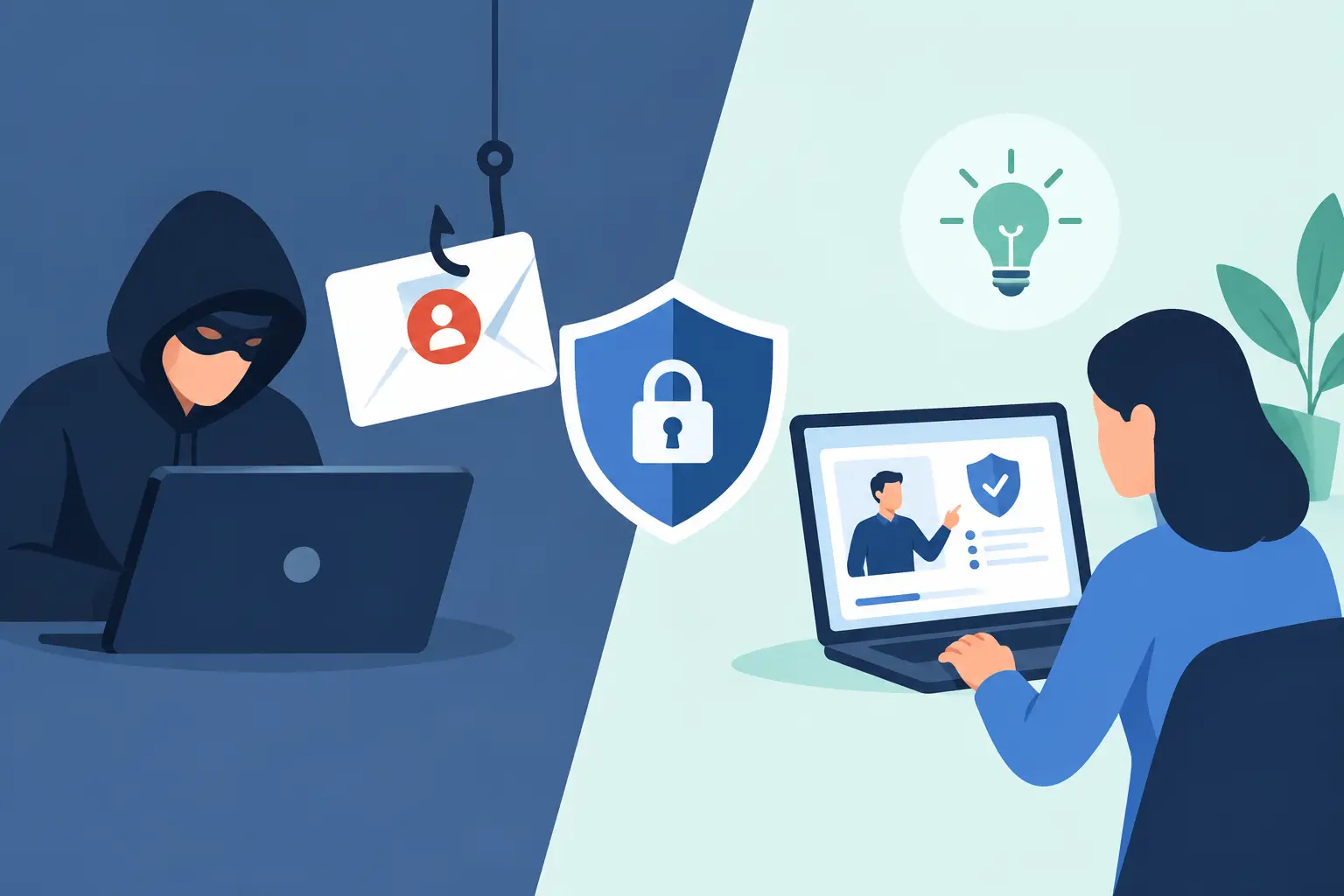
A finance colleague receives an email that appears to be from Microsoft 365, asking them to re-authenticate before a document can be viewed. They hesitate, report it, and the security team confirms it was a real credential-harvesting attempt. That outcome is rarely the result of one annual course or one test. Phishing simulation versus awareness training is not an either-or technology decision. It is a question of how an organisation develops, measures and sustains human risk reduction.
For UK organisations facing ransomware, business email compromise and tighter governance expectations, both capabilities can be valuable. They serve different purposes, produce different evidence and demand different levels of operational care. Treating them as interchangeable often creates a programme that is easy to procure but difficult to defend.
Phishing simulation versus awareness training: the essential difference
Phishing simulation is a controlled test of how people respond to realistic, but harmless, suspicious emails. A platform sends selected scenarios to users and records actions such as opening the message, clicking a link, entering details, reporting the email or ignoring it. Its primary value is behavioural measurement in a context that resembles an actual attack.
Security awareness training is structured education. It may cover phishing, password hygiene, MFA fatigue, social engineering, safe use of SaaS applications, data handling, remote working and incident reporting. Delivery can include short modules, videos, policy acknowledgements, quizzes and role-based learning. Its primary value is building knowledge, judgement and shared security expectations.
The distinction matters because a low click rate does not prove that employees understand their responsibilities, and high training completion does not prove that they will recognise a convincing phishing attempt under pressure. One assesses observable behaviour at a point in time; the other develops capability over time.
What each approach tells a security team
A well-designed simulation programme gives security leaders evidence that traditional training reports cannot. It can show which departments are most likely to interact with credential-theft lures, whether users report suspicious messages promptly, and whether risk differs by location, seniority or role. Repeated campaigns can also indicate whether interventions are improving behaviour.
However, simulation metrics need interpretation. A click on a well-crafted scenario may reveal a useful coaching opportunity, but it is not a complete measure of an individual’s security competence. Users may click because the message was relevant to a live business process, because they were working quickly, or because the simulation imitated a trusted supplier particularly well. A reported phish can be a more meaningful positive signal than a click is a negative one.
Awareness training offers a broader governance view. Completion records and assessment results support policy compliance, audit preparation and regulatory expectations. More importantly, role-specific content can address risks that email simulations cannot test effectively. Finance teams may need guidance on payment-change verification; HR teams may need to identify recruitment fraud and protect special-category data; developers may need secure coding and secrets-management education.
The limitation is familiar to most security managers: completion is an administrative metric, not an outcome metric. If every employee finishes a generic annual module but suspicious emails are rarely reported, the programme may be compliant on paper while leaving exposure unchanged.
Why a combined programme usually performs better
The strongest approach uses awareness training and simulations as connected controls, not competing products. Training establishes the principles: pause before acting, verify unusual requests through a separate channel, protect credentials, and report suspected phishing. Simulations then test whether those principles translate into daily decisions.
This connection should be deliberate. If a campaign uses a QR-code phishing scenario, learning content should explain QR risks and safe verification methods beforehand or immediately afterwards. If users struggle with invoices or shared-document lures, the next training cycle should reflect the pattern. The security team gains a practical feedback loop rather than two disconnected reporting dashboards.
For many organisations, short, frequent learning supported by periodic simulations is more effective than a long annual course followed by punitive testing. The right cadence depends on the threat profile, workforce size, sector and operational disruption tolerance. A healthcare provider, for example, must balance education with clinical workloads, while a financial services firm may justify more frequent, role-specific testing due to payment fraud exposure.
Choosing the right balance for your organisation
A simulation-led programme may be the immediate priority where the organisation already has baseline training but lacks evidence of real-world behaviour. It can be particularly useful after a rise in credential theft, a near miss involving business email compromise, or concerns that reporting processes are unclear. In these cases, early campaigns should establish a baseline, not create a league table of failures.
Training-led investment may come first where education is inconsistent, induction is weak, or staff lack clear guidance on reporting, passwords, data classification and acceptable use. Organisations subject to demanding compliance obligations also need an auditable learning framework, including role-based assignments and policy records, alongside behavioural testing.
Buyers should assess capability beyond the campaign template library. Relevant questions include whether the platform supports Microsoft 365 and Google Workspace environments; whether it can integrate with the existing email security stack; how reporting data is segmented; and whether administrators can tailor content for job roles, languages and risk groups. For UK organisations, data processing arrangements, retention controls and user privacy also require scrutiny.
Ease of administration matters. A sophisticated platform that requires extensive manual list management, complex campaign creation and separate reporting exports may not suit a lean IT team. Conversely, a large enterprise with a mature security operations function may want granular targeting, API integrations, custom templates and reporting that can feed risk and compliance dashboards.
Avoid turning simulations into a disciplinary tool
The quickest way to undermine a phishing programme is to make people fear it. Publicly identifying users who click, automatically escalating every failure to line managers, or delivering shaming messages may suppress honest reporting. It can also encourage staff to avoid engagement rather than learn safer habits.
That does not mean results should be ignored. High-risk patterns require proportionate action, especially for privileged users, finance teams and executives who are common targets for impersonation. The response should be constructive: immediate micro-training after a risky action, targeted follow-up where patterns persist, and additional controls for roles with material financial or data access.
Security leaders should also avoid making simulation click rate the sole programme KPI. A balanced scorecard is more defensible. It can include reporting rate, time to report, repeat-risk trends, training completion and assessment performance, coverage of priority roles, and the volume of real suspicious emails reported to the security team. Where possible, relate these measures to broader controls such as MFA adoption, email security outcomes and incident trends.
Procurement considerations beyond the feature list
Security awareness platforms vary considerably in content quality, simulation realism, analytics and managed service options. Some are strongest in engaging learning content; others offer more mature phishing simulation libraries, adaptive risk scoring or integrated email reporting. There is no universally best platform because the operational requirement is not universal.
Before selecting a supplier, define what a successful first year looks like. That might mean 95 per cent training completion across the workforce, a substantial increase in reported suspicious emails, simulation coverage for all high-risk functions, or clear evidence of reduced repeat-risk behaviour. Set targets that account for the starting position rather than borrowing benchmarks from unrelated organisations.
It is equally sensible to involve HR, legal, compliance and internal communications early. They can help establish fair user messaging, appropriate data handling and a campaign approach that supports the organisation’s culture. Procurement should also confirm licensing assumptions, contractor coverage, content refreshes, support model and implementation effort. A low headline licence cost can become less attractive if the platform needs heavy administration or cannot provide meaningful reporting.
An independent assessment can help compare these trade-offs without forcing the programme into one vendor’s preferred model. ITR Cyber helps organisations evaluate security awareness and phishing capabilities alongside the wider controls that shape email and identity risk, from email security to endpoint protection and incident response.
Make reporting the behaviour you reward
The most useful employee response to a suspected phish is often not merely avoiding a click. It is reporting the message quickly enough for the security team to investigate, remove similar emails and protect other users. Make reporting simple, explain what happens after a report, and acknowledge useful reports even when the message turns out to be legitimate.
A mature programme should leave people more confident, not more anxious. Choose phishing simulations that measure realistic risk, pair them with relevant awareness training, and use the findings to improve both technical controls and everyday decision-making. That is how human risk becomes a manageable part of cyber resilience rather than an annual compliance exercise.