
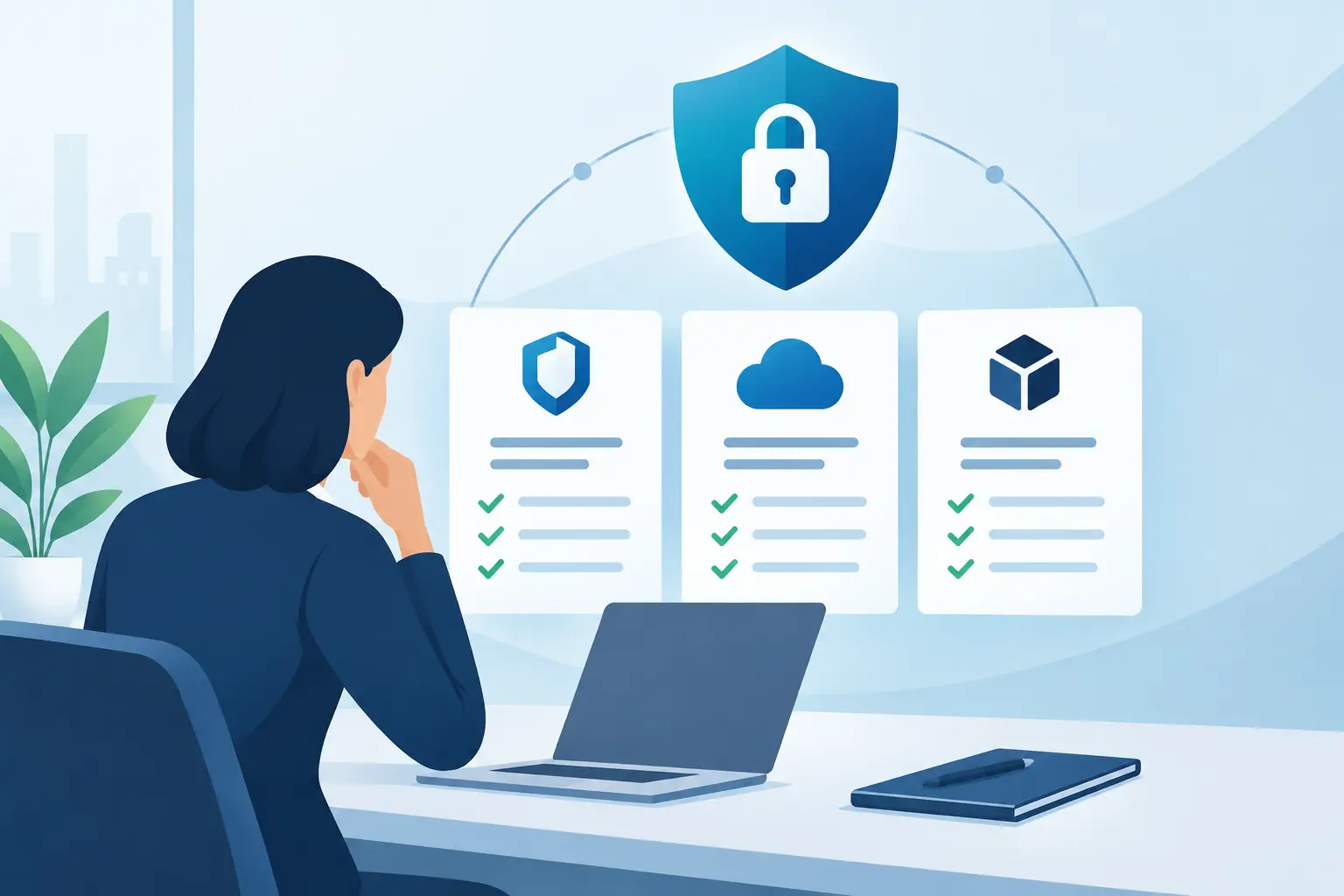
A cybersecurity vendor evaluation can fail long before a product demonstration. It fails when an organisation starts with a vendor category rather than a defined security problem, lets a polished console outweigh operational evidence, or treats procurement as the end of the decision. The result is often another security tool that creates alerts, administration and renewal costs without materially reducing risk.
For UK organisations balancing ransomware exposure, regulatory scrutiny, constrained security teams and a crowded technology market, the objective is not to identify the product with the longest feature list. It is to select a solution that improves prevention, detection, response or governance in the environment you actually operate - and that your people can sustain.
Start cybersecurity vendor evaluation with the risk
Security technology should follow a clear risk decision. Before comparing EDR, email security, data security or attack-surface management providers, establish what needs to change. A board concern about ransomware is not yet a set of technical requirements. It may point to unmanaged endpoints, weak identity controls, poor recovery assurance, insufficient network segmentation or a lack of response capability outside working hours.
Translate the business concern into use cases that can be tested. For example, an organisation replacing endpoint protection may need to contain a compromised device quickly, identify lateral movement, investigate suspicious activity without specialist tooling, and provide evidence for cyber insurance or auditors. A legal firm protecting client information may instead prioritise visibility of sensitive data movement across Microsoft 365, endpoints and cloud services.
This work also prevents category errors. XDR may be valuable where endpoint, email, identity and cloud telemetry can be meaningfully correlated. It may be excessive where the immediate weakness is phishing resilience or unsupported devices. A platform is not automatically the better choice simply because it covers more domains.
Define outcomes, constraints and owners
A useful evaluation brief states the security outcome, the operational constraint and the accountable owner. It should answer practical questions: Which threats are most likely to disrupt the organisation? Which regulatory or contractual duties apply? Who will monitor alerts, tune policies and own incident response? What is the acceptable deployment window? Which existing systems, such as Microsoft 365, SIEM, identity provider or service desk, must integrate?
Commercial constraints belong in the brief too. Licence metrics, minimum commitments, multi-year terms, data-retention charges, professional services, managed detection and response, and renewal uplifts can change the total cost substantially. A low entry price is not a lower-cost decision if the product requires extra staff time or separate tooling to be effective.
Build a scorecard before seeing the demo
Vendors naturally demonstrate their strongest capabilities. A scorecard keeps the selection process tied to requirements rather than presentation quality. Weight each criterion according to its relationship to risk, then agree the scoring approach across security, IT operations, procurement, compliance and the service owner before demonstrations begin.
For many evaluations, the scorecard should assess security efficacy, integration and architecture, operational usability, implementation effort, vendor and partner support, commercial terms, and governance evidence. The exact weighting depends on the situation. A lean IT team may give greater weight to policy management, alert quality and managed-service options. A mature security operations centre may place more value on telemetry depth, APIs, threat hunting and control over data retention.
Avoid scoring vague statements such as “market leading” or “AI-powered”. Ask what the capability does in a specific workflow. If a platform claims autonomous ransomware protection, can it prevent encryption, isolate a device, roll back affected files, preserve forensic evidence and notify the right team? What conditions, exclusions and recovery steps apply?
Separate essential requirements from preferences
An essential requirement is a condition that must be met for the solution to be viable. This could include UK data-residency requirements, support for a legacy operating system, integration with a named identity provider, 24/7 response coverage, or the ability to maintain a centralised risk register for multiple entities. A preference may improve the experience but should not override a critical gap.
This distinction is particularly important when comparing specialist products against broader suites. A suite can reduce supplier count and simplify commercial management, but its individual controls may not meet a high-risk use case as effectively as a specialist provider. Conversely, selecting the strongest standalone product in every category can create integration overhead, duplicated telemetry and an unmanageable renewal calendar. The right balance depends on the organisation’s skills, architecture and risk tolerance.
Test the product in your environment
A proof of value is more useful than an extended sales demonstration when it is focused, time-bound and measured. It should test the scenarios that informed the evaluation brief, using a controlled group of representative users, endpoints, cloud workloads or mailboxes. The purpose is not to recreate every attack technique. It is to establish whether the product works with your systems and operating model.
For endpoint security, test agent deployment, policy management, endpoint performance, alert fidelity, isolation actions, investigation workflows and compatibility with existing controls. For email security, examine phishing detection, false-positive handling, post-delivery remediation, reporting and the process for releasing legitimate messages. For data security, test classification accuracy, access visibility, remediation paths and whether business teams can understand and act on findings.
Document the evidence as the trial proceeds. Record failed integrations, configuration dependencies, support response times, training needs and workarounds as well as successful outcomes. The product with fewer detections is not necessarily weaker if it produces more actionable alerts and reduces time spent investigating benign activity.
Evaluate the operating model, not only the console
A security control is only protective if it is operated consistently. Ask who receives alerts at 02:00, who approves containment, who maintains exclusions, and how changes are reviewed. Where a managed service is involved, clarify the division of responsibilities: does the provider merely notify, or can it investigate and take approved response actions? What is the escalation path during a serious incident?
Also assess deployment support realistically. An implementation plan should cover discovery, pilot scope, policy design, phased rollout, integrations, administrator training, acceptance criteria and handover. Organisations frequently underestimate the time needed to remove legacy agents, rationalise policies and align incident procedures. A supplier that can support procurement but not adoption leaves much of the value unrealised.
Assess vendor viability and commercial exposure
Technical fit matters, but a cybersecurity vendor evaluation should also examine the supplier relationship. Consider the vendor’s product direction, support model, release practices, vulnerability disclosure process, service availability commitments and financial stability. For regulated sectors, establish how the provider supports audit requests, data processing obligations, retention controls and evidence gathering.
Contract review should make operational assumptions explicit. Confirm licence counting rules, overage treatment, renewal notice periods, price-protection provisions, support tiers, exit terms and the process for retrieving or deleting data. If the service relies on a partner for implementation or first-line support, document where accountability sits. A fragmented support arrangement can be most visible during an incident, when there is no time to negotiate ownership.
Independent comparison is valuable here because manufacturer-led proposals can be shaped by product availability and sales targets. ITR Cyber helps organisations compare suitable technologies against stated requirements, coordinate vendor engagement and make the commercial route as defensible as the technical decision.
Make the decision defensible
The final recommendation should not simply name a winner. It should show the requirement traceability, evaluation evidence, known compromises, total cost over the expected term, implementation plan and residual risks. This gives procurement teams a clear basis for negotiation and gives senior stakeholders confidence that the choice reflects business exposure rather than individual preference.
There may be no perfect result. One platform may offer stronger detection depth but require more specialist operational skills. Another may be easier to deploy and manage but provide less granular investigation capability. State those trade-offs plainly, then decide whether they are acceptable in the context of available people, budget and risk appetite.
The most valuable technology decision is one your organisation can explain, implement and operate six months after purchase. Treat the evaluation as the beginning of that operating commitment, and the security investment is far more likely to deliver the protection it promised.