
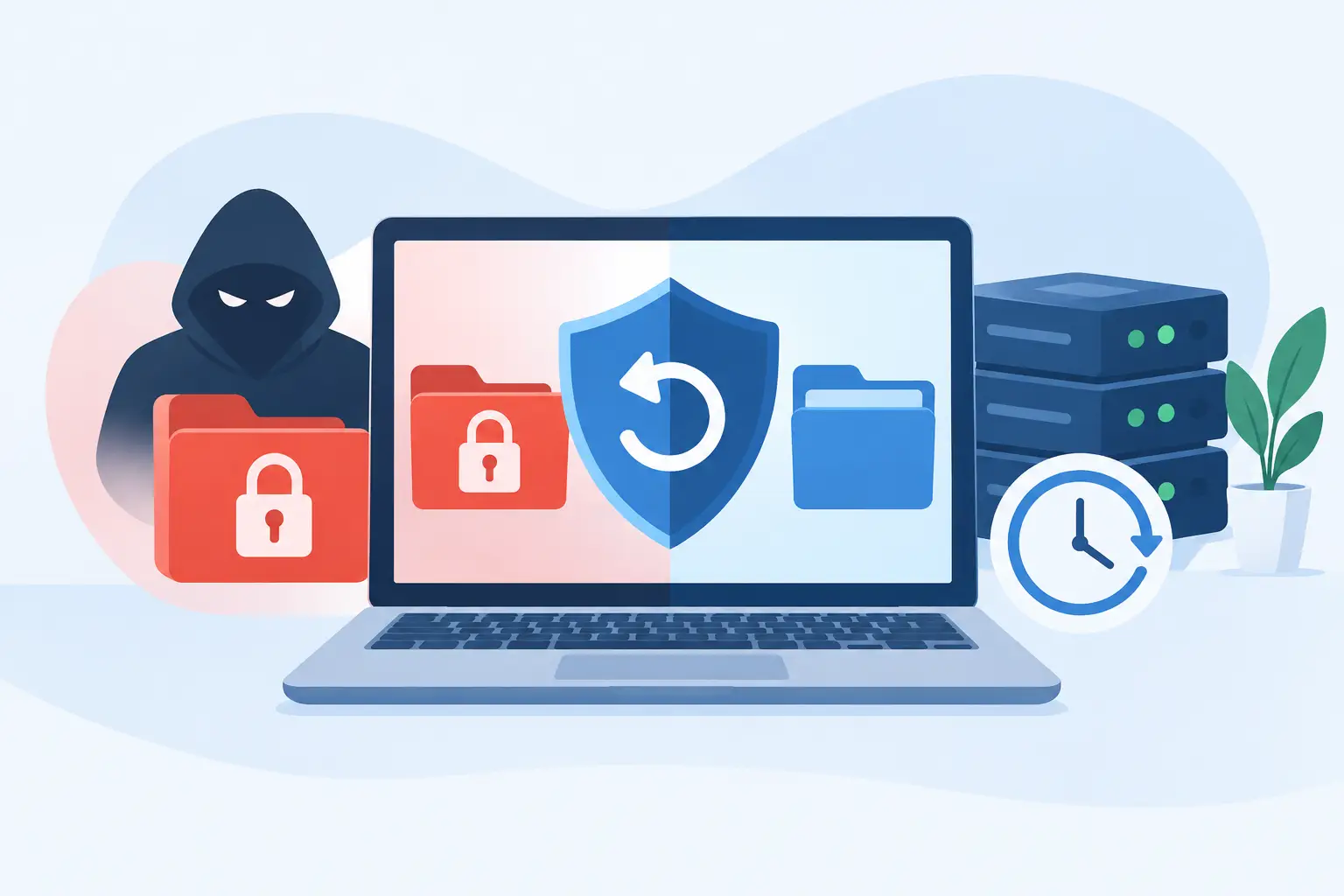
A ransomware incident rarely fails because an organisation has no security tools. It fails because the controls that should contain damage, preserve evidence and recover affected systems were never configured for the way the business actually operates. To configure ransomware rollback policies effectively, security teams must decide what can be reversed, when rollback is permitted and how recovery will be validated before an attack creates time pressure.
Rollback capability can materially reduce the impact of endpoint ransomware, particularly where an EDR or XDR platform can identify malicious encryption activity and restore changed files. It is not, however, a substitute for tested backups, incident response procedures or sound identity controls. A policy that restores data too aggressively can overwrite evidence or reintroduce a compromised state. A policy that is too restrictive may leave operations waiting for manual intervention during a serious outage.
What ransomware rollback can and cannot do
Ransomware rollback generally refers to an endpoint security platform reversing unauthorised file changes after it detects malicious activity. Depending on the product, this may rely on local file journals, protected copies, operating system features or a platform-specific recovery mechanism. The scope can vary considerably between vendors, operating systems, licensing tiers and agent configurations.
That distinction matters when assessing products. Some platforms offer rollback primarily for Windows endpoints. Others focus on prevention and behavioural detection, leaving recovery to backup and restoration tools. Some can reverse file encryption but cannot restore data held in cloud applications, network shares or unsupported devices. A policy should reflect the capability that has been validated in your own estate, not a broad assumption based on a product datasheet.
Rollback also has a different purpose from backup. Backups are designed for recoverability across wider failure scenarios, including server loss, accidental deletion and long-term retention. Endpoint rollback is designed to reduce disruption quickly on a compromised device. Organisations need both, with clear ownership between security, infrastructure and business continuity teams.
Set the policy objectives before changing settings
The right rollback policy begins with business impact, not with a vendor console. Start by identifying the endpoint groups where rapid restoration would make the greatest operational difference. Finance workstations, clinical devices, legal case-management endpoints, engineering systems and privileged administrator devices may all need different treatment.
For each group, establish the acceptable recovery objective. A standard user laptop may be isolated automatically and restored after a high-confidence detection. A device involved in regulated processing may require security approval before any rollback begins, because preserving forensic artefacts and maintaining an auditable chain of events is more important than immediate return to service.
This is also the point to confirm governance requirements. UK organisations operating in regulated sectors may need to demonstrate who authorised recovery, what files were restored, whether personal data was affected and how the incident was recorded. Rollback events should feed into the incident-management process and, where appropriate, a centralised risk register rather than remain as isolated endpoint alerts.
How to configure ransomware rollback policies
Define groups by risk and business function
Avoid a single policy applied to every endpoint. Create logical groups based on operating system, user privilege, data sensitivity, business criticality and support model. Servers, kiosks, shared clinical workstations and developer devices usually deserve separate policies from standard corporate laptops.
A phased approach is commercially sensible. Begin with a pilot group whose applications and data flows are well understood, then review alerts, recovery outcomes and service-desk impact before extending the configuration. This reduces the risk that a new setting disrupts specialist software or creates unnecessary operational workload.
Set a high-confidence trigger for automated action
The policy should distinguish between detection, containment and rollback. Behaviour associated with ransomware - such as rapid file encryption, suspicious process chains or attempts to delete recovery data - may justify immediate network isolation. Automatic rollback should normally require high-confidence malicious activity, especially where the endpoint stores evidential, financial or regulated data.
It depends on the environment. A small organisation with limited out-of-hours security coverage may accept automated isolation and rollback for managed Windows endpoints. A larger enterprise with a security operations centre may prefer automatic isolation followed by analyst approval for rollback. Neither model is universally right. The defensible choice is the one aligned to the organisation’s recovery objectives, monitoring coverage and tolerance for false positives.
Protect the rollback mechanism itself
A rollback function is only useful if ransomware cannot disable it before encryption begins. Confirm that the endpoint agent has tamper protection enabled, that users cannot stop or uninstall it, and that local administrative rights are tightly controlled. Attackers commonly target security tooling, shadow copies and backup agents early in an intrusion.
Review exclusions with particular care. Broad exclusions for folders, processes or development tools can create a path around behavioural protection and recovery controls. Every exclusion should have a documented owner, business justification, expiry or review date, and testing evidence. This is an area where convenience can quietly become material risk.
Choose retention and capacity with evidence in mind
Rollback data consumes local storage or relies on a platform-managed mechanism. Retention must therefore balance recoverability against endpoint performance, disk capacity and the time likely to pass before detection. A device that is offline for extended periods may need a different approach from a continuously connected office laptop.
Do not configure the shortest retention period simply to reduce storage use. Consider how quickly alerts are triaged, whether incidents are investigated outside working hours, and whether an attacker could remain undetected before encrypting files. Equally, longer retention is not automatically better if it affects endpoint stability or conflicts with an application’s normal file-handling behaviour.
Control network and shared-data exposure
Endpoint rollback cannot always repair files encrypted on network shares, file servers or SaaS platforms. A compromised user account may also encrypt accessible data from a clean device, meaning the endpoint itself is not the only recovery concern.
The policy should therefore sit alongside least-privilege access, multi-factor authentication, network segmentation and immutable or protected backups. Review where users can write data, which service accounts have broad permissions and whether unusual mass file activity can be detected. This wider control set is often more valuable than attempting to make an endpoint feature solve a data-governance problem.
Test rollback as an operational process
A successful configuration in a console is not proof of recovery. Test it in a controlled environment using approved ransomware simulation techniques or safe file-encryption tests. Validate not only whether files return, but whether the endpoint is isolated, malicious processes are terminated, alerts reach the right team and normal business applications still function afterwards.
Document the test result for each key endpoint group. Capture recovery time, files restored, exceptions encountered, manual steps required and any gaps involving shared storage or cloud data. These findings should inform both the security policy and procurement decisions, particularly when comparing EDR or XDR platforms with different recovery models.
It is worth testing difficult cases: an endpoint with low disk space, a remote user on an unreliable connection, a device with sensitive local data, and a system where ransomware activity occurs through a compromised privileged account. The goal is not to prove that the technology performs perfectly. It is to know where human decision-making, backup restoration or specialist support will still be required.
Build clear roles into the response plan
Rollback policies need named operational owners. Security teams may own detection thresholds and containment rules; infrastructure teams may own endpoint compatibility and backup recovery; service desks may support users after restoration; compliance leaders may need visibility of reportable incidents. Without this clarity, an automated control can trigger confusion at precisely the wrong moment.
Create an approval path for cases where rollback could affect evidence, regulated data or business-critical applications. Define who can release an isolated device, who verifies recovery, and who decides when an incident is closed. Keep the procedure short enough to use under pressure, then rehearse it with the teams expected to act.
Independent comparison is useful here because rollback is only one part of the buying decision. The right platform depends on endpoint coverage, detection quality, operating system support, management overhead, integration needs and the maturity of the internal response team. ITR Cyber can help organisations assess these trade-offs without forcing requirements into a single vendor’s model.
A well-designed rollback policy should give teams a faster route back to safe operations, not a false sense of safety. Treat each test, exception and recovery decision as evidence for improving the policy, and the organisation will be better prepared when a real incident demands action.