
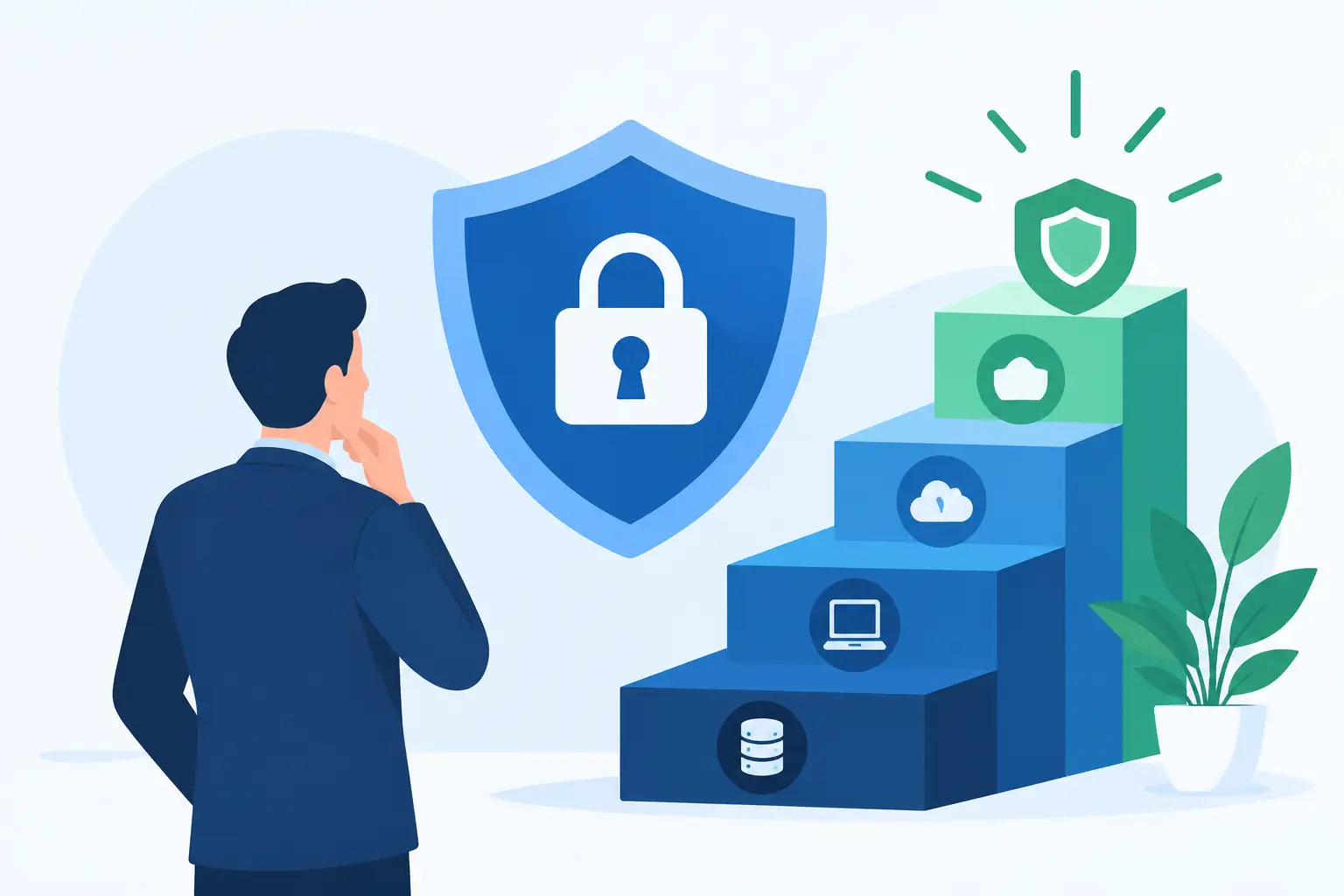
A board-approved security budget can disappear quickly when every vendor demonstration identifies a genuine problem. The challenge is not finding worthwhile technology. It is deciding what reduces your organisation’s most material risk first. Knowing how to prioritise security investments turns a long product shortlist into a defensible plan for protection, procurement and deployment.
For UK organisations, that plan must account for more than threat headlines. It needs to reflect the systems that keep services running, the data that creates regulatory exposure, the controls already in place, the skills available to operate new platforms and the consequences of disruption. A sophisticated XDR platform may be the right answer for one business, while another will gain more immediate value by closing unmanaged endpoint gaps, improving email protection or putting ownership around third-party risk.
Start with business impact, not a product category
Security investment should begin with the outcomes the organisation cannot afford to lose. For a law firm, that might be confidential client data and continued access to case files. For a manufacturer, it may be production continuity and the separation of operational technology from corporate IT. A healthcare provider may place patient safety, clinical availability and sensitive-data handling at the centre of its assessment.
Translate those outcomes into a small number of credible loss scenarios. Examples include ransomware stopping operations, business email compromise causing fraudulent payments, privileged-account compromise exposing sensitive data, or a supplier incident disrupting a critical service. The aim is not to produce an exhaustive threat catalogue. It is to establish which events would cause the most significant financial, operational, legal or reputational harm.
This changes the investment conversation. Instead of asking whether EDR, email security or security awareness training is generally valuable, ask which capability most reduces the likelihood or impact of a defined scenario. That distinction makes it easier to explain choices to senior leadership, auditors and procurement teams.
Build a current-state view before spending
A priority is only meaningful when measured against existing controls. Many organisations buy overlapping tools because no one has a clear view of coverage, configuration quality, ownership or operational use. A platform may be licensed across the estate but not deployed to every endpoint. Multi-factor authentication may exist, yet exclusions and legacy access paths may leave the highest-risk accounts exposed.
Create a practical control baseline across identity, endpoints, email, cloud and SaaS applications, data, networks, users, third parties and incident response. For each area, record what is deployed, where it is active, who owns it, what alerts or evidence it produces, and where the known exceptions sit. Centralised risk registers are useful here, particularly where security, compliance and supplier assurance teams need a common view.
The output does not need to be a lengthy maturity report. It needs to be accurate enough to identify material gaps and avoid purchasing technology that duplicates an underused capability. In some cases, the highest-return investment is not a new platform at all. It may be completing an EDR rollout, tuning email controls, removing stale privileged accounts or ensuring incident-response procedures are tested.
How to prioritise security investments by risk reduction
A useful prioritisation method weighs each proposed investment against the same criteria. The exact scoring model will vary, but the decision should consider the following four questions together:
- How much material risk does it reduce, and which business scenario does it address?
- How exposed is the organisation now, considering control gaps, attack surface and known weaknesses?
- How quickly can the capability be deployed and produce usable protection?
- Can the organisation operate it effectively, including monitoring, investigation, maintenance and response?
Risk reduction should carry the greatest weight. A low-cost project is not automatically a priority if it has little bearing on the threats most likely to interrupt the business. Equally, a high-impact platform may need to be phased if it requires identity clean-up, data classification or specialist resources before it can work as intended.
Add two further commercial factors: total cost of ownership and dependency. Total cost includes implementation, integrations, internal administration, training, managed services and renewal exposure, not simply the initial licence price. Dependency considers whether a project enables several later improvements. Identity hardening, for example, often strengthens endpoint, cloud, SaaS and privileged-access security simultaneously.
A simple heatmap can communicate the result, but do not let a scoring exercise create false precision. If two investments have similar scores, use judgement. A time-sensitive regulatory requirement, an active exploitation trend affecting your estate or a major contract renewal may justify changing the sequence.
Separate urgent exposure from strategic capability
Most security roadmaps need two workstreams. The first addresses urgent exposure: unsupported systems, missing endpoint coverage, vulnerable internet-facing assets, weak administrator controls, insecure remote access or a rise in phishing-related incidents. These issues usually justify immediate action because they present a clear route to compromise.
The second builds strategic capability. This can include XDR adoption, data security posture management, security awareness programmes, attack-surface intelligence, governance, risk and compliance workflows, or mature third-party assurance. These investments may not resolve a single emergency, but they improve visibility, decision-making and resilience over time.
The mistake is treating these as competing priorities. A roadmap focused only on urgent fixes can become permanently reactive. One focused only on transformation can leave known gaps open for too long. Allocate budget and delivery capacity to both, with a clear explanation of the trade-off. For example, a business may first standardise endpoint protection and ransomware controls, then use the stabilised endpoint estate as the foundation for wider XDR detection and response.
Test operational fit before selecting a platform
A technically strong solution can fail commercially if it creates more alerts than the team can investigate, requires integrations that are not available, or depends on data quality the organisation does not yet have. Product evaluation should therefore include operational fit from the outset.
Ask how the platform will be deployed across different operating systems, remote workers, cloud workloads and subsidiaries. Establish whether your internal team will manage policy, triage alerts and lead investigations, or whether a managed service is required. Check how the tool fits existing identity providers, SIEM, service desk, vulnerability management and incident-response processes.
This is also where independent comparison is valuable. Vendor demonstrations naturally show each product at its best. A fair assessment compares detection quality, coverage, integration effort, management overhead, service model, licensing approach and the limitations that matter in your environment. The right product is rarely the one with the longest feature list. It is the one that provides sufficient protection and evidence without creating an unsustainable operating burden.
Make the business case measurable
Security proposals gain traction when they describe a reduction in exposure rather than a collection of features. Tie each investment to a measurable objective. That may mean increasing managed endpoint coverage from 75% to 98%, reducing high-risk identity exceptions, shortening mean time to contain an incident, improving phishing-reporting rates or bringing critical supplier assessments into a consistent workflow.
Not every security benefit can be expressed as a precise financial figure. However, decision-makers should be able to see what will change, who is accountable and how progress will be reviewed. Define a baseline before implementation, then agree a small set of reporting measures that show adoption, effectiveness and residual risk.
Avoid promising that a tool will eliminate ransomware, phishing or data loss. No product can do that alone. A stronger proposal explains how a capability works alongside people, processes and existing controls to reduce the probability of harm and improve recovery when prevention fails.
Review the roadmap as conditions change
Prioritisation is not an annual spreadsheet exercise. Acquisitions, cloud migrations, new suppliers, audit findings, emerging vulnerabilities and changes in attacker behaviour can all alter what deserves attention. Review the roadmap quarterly, and revisit it immediately after a material incident or significant business change.
Keep a record of why a decision was made, including assumptions about risk, budget, internal capacity and planned integrations. This creates an audit trail and prevents teams from revisiting the same debates without context. It also helps when a deferred initiative becomes urgent later.
The best security investment plan is not the one with the most technologies. It is the one that makes the next defensible decision clearer, reduces the risks that matter most and leaves the organisation better able to act when the threat landscape changes.